
|
A very rare ARP badge for second world war helmet manufacturer Rubery Owen & Co. Ltd has appeared on eBay. I've not seen this design of badge before. During the war they manufactured parts for aircraft and also supplied tens of thousands of helmets for use both in the services as well as for Civil Defence.  WW2 Rubery Owen & Co. Ltd. ARP Badge
0 Comments
An interesting grouping of Civil Defence and ARP insignia is coming to auction on 7 June. A rare District Warden armband is included (looks like it has had some adaptation with a buckle having been added) as well as four sleeve ranks badges. Also in the grouping are a couple of rare I.O. (Incident Officer) sleeves badges in the London script style and a St. John Ambulance Association first aid badge. Additionally, a pair of Fire Guard Sector Captain's shoulder titles are included. A nice little grouping for the Potters Bar area. The lot (#1396) can be viewed on Cadman Auctions.  WW2 Potters Bar District Warden and Civil Defence/ARP Insignia Thought to have first appeared at one of the military shows a few years ago, these fake ARP London Transport have been doing the rounds since. They crop up from time to time on the usual online auction sites (like the below example) and also as items at auction houses. They are a fantasy item.  Fake WW2 ARP London Transport Badge Not seen for a few years but now back like the proverbial bad penny is this fantasy AVRO battledress. We've seen fake AVRO insignia many times before. Being hawked by a well-known shyster of militaria, the jacket is even post-war (it's has had the WD number messed with) and also had some spurious maker's mark daubed inside (they were always on white labels). The badges are utter fantasy as well. Hopefully, people may look to research the BD and learn it is complete garbage before wasting their hard-earned on it.  Fake AVRO Lancaster Factory ARP Battledress
A good chance to compare two District / Divisional Wardens' helmets on eBay; an original helmet (priced at £65 buy it now) v a fake helmet (from the Stansted Shyster at £175. Always good to know who the utter tosspots on eBay are, and to avoid them like the plague they are.
A very interesting photo of a Home Guard platoon from Lyminge. Quite rare to see Civil Defence defence personnel wearing webbing and with rifles (Lee-Enfield No. 4 rifles). Members of the Home Guard could also serve in the Wardens' Service and they would wear shoulder titles for both. They would wear the KT and 7 insignia and a few appear to have the East Kent District insignia (featuring the White Cliffs and Dover Castle). Chap in the centre is a lieutenant with a sergeant to the left (wearing the stripes). The insignia on the left sleeve in a red HG proficiency award. The Home Guard was stood down in late 1944 and it's possible the photo dates from this period. They also have four war service chevrons on their right sleeve. All bar one are wearing the austerity pattern battledress with exposed buttons. Photo credit via Dave Harman.  16 CD Platoon 7th Home Guard Lyminge, Kent
A large number of the lamps that attached to helmets date from the post war period. They are often boxed and have a red and black twisted cord. They are labeled as "LAMP SPOT ELECTRIC WITH HELMET CLIP". The below is I believe a wartime dated example and includes on the box "SHRAPNEL HELMET LAMP" and has a plain black cord connecting the lamp to the battery. Very few period photos show the lamp being worn; though there is one of a Lewisham volunteer.  Shrapnel Helmet Lamp  Shrapnel Helmet Lamp Box Photo from the Sunderland Echo showing a number of wardens from Norfolk Street. Of interest is the reverend in the middle. He has marked up his helmet with a cross and W and is wearing the ARP chaplain's armband that featured a cross below red ARP letters. A distinct lack of any uniforms.  Air Raid Precautions Wardens in Norfolk Street, Sunderland in December 1939 Eric Caxton was a pre-war highways engineer who became involved with civil defence planning run by Surrey County Council. Early in the war he helped set up the Rescue School at Redhill. In 1942 Caxton set up the Casualties Union and introduced into civil defence training the idea of casualty simulation whereby instead of extricating dummies from bombed buildings during training, real people were used that had been made-up to look injured. The Casualties Union continues to this day. Caxton wrote a number of guides, such as "Practical Rescue Training" handbook shown below, as well as a autobiography entitled "More Ways Than One of Fighting a War". The below is currently for sale on eBay for £40. 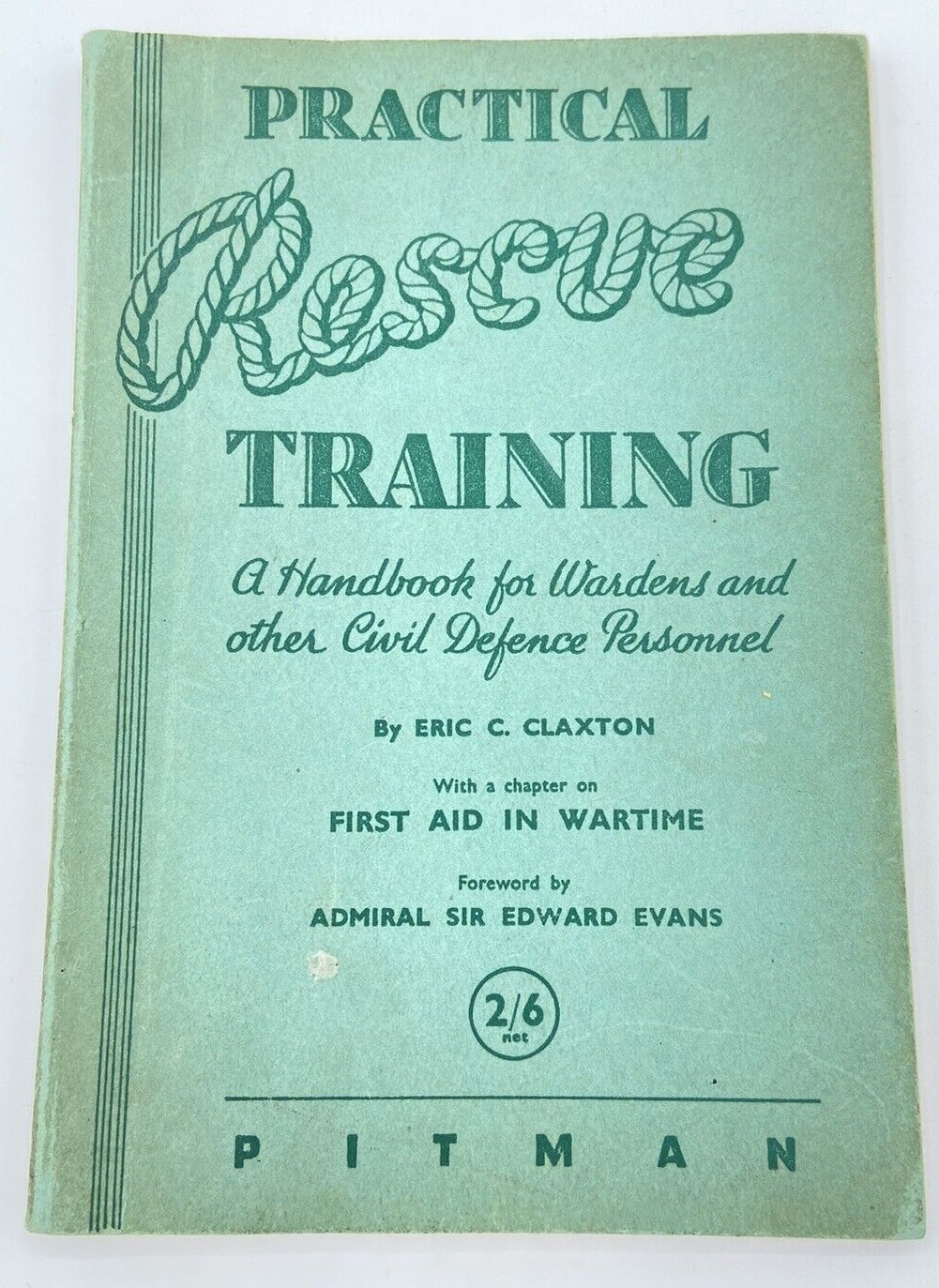 Practical Rescue Training Booklet by Eric Caxton Few original ARP signs are still in situ but affixed high up on the wall of Cullompton Town Hall in Devon is this beauty - ARP FIRST AID POINT - on the far left of the image. I'm guessing the position it occupies has seen it survive the many decades without being removed or pinched. Shows how good quality they were. It appears there are two different styles of cross - one red and one white in a red circle.  Cullompton Town Hall with ARP FIRST AID POINT sign
There were a few common Civil Defence badges regularly seen today. Below is one of them and also a gentleman wearing it.  Small Civil Defence Lapel Badge  Detail of Small Civil Defence Lapel Badge Kent created the first convoy of mobile reserve in 1940 and it formed the basis for all other Mobile Reserve (in East & West Sussex) and Civil Defence Reserve formations that followed around the country. Below is a photo of a few of the vehicles that comprised the mobile reserve. The vehicles were to also have the emblem shown below added to the vehicles.  Kent Mobile Reserve Vehicles  Kent Mobile Reserve Vehicle Emblem |
PLEASE SUPPORT THIS WEBSITE'S RUNNING COSTS AND KEEP IT ADVERT FREE
Categories
All
Archives
November 2026
|


 RSS Feed
|
|
Copyright © 2018–2026
|

